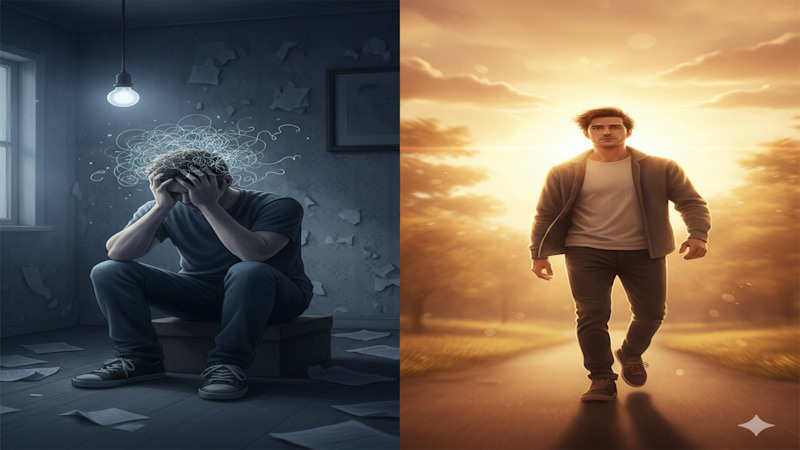
What if anxiety isn’t a signal to think harder—but a signal to move?
That question flipped my relationship with anxiety upside down. For years, I tried to outthink it. Journals. Podcasts. Late-night mental debates. Guess what? Anxiety loved that. It grew stronger. Louder. More convincing.
Everything changed when I did something small instead of thinking something big.
This article isn’t about pretending anxiety doesn’t exist. It’s about meeting it with action—imperfect, messy, human action. The kind that actually works.
Let’s break it down.
1. Anxiety Thrives on Stillness—Action Breaks the Spell
Anxiety feeds on pauses. On waiting. On “I’ll do it later.”
The moment you stop moving, your mind fills the silence with what ifs.
Think about it.
You sit still.
Your brain starts scanning for danger.
It finds imaginary futures and treats them like facts.
That’s anxiety’s home turf.
Action does something powerful: it interrupts the loop.
Even tiny movement helps:
- Standing up
- Washing your face
- Sending one awkward email
- Taking a five-minute walk
You’re telling your nervous system: We’re not stuck.
And here’s the secret—your brain calms down after your body moves, not before.
Waiting for calm is a trap.
Moving creates calm.
Ask yourself: What’s the smallest action I can take right now?
2. Thinking Feels Productive—But It’s Often Avoidance
Let’s be honest.
Overthinking feels smart.
You analyze.
You plan.
You replay conversations like a Netflix series.
But most of the time? That’s fear wearing a clever disguise.
I once spent weeks “preparing” for a simple phone call. Scripts. Notes. Timing strategies.
You know how long the actual call took?
Four minutes.
Anxiety loves preparation because preparation delays exposure.
Action forces exposure—and exposure shrinks fear.
Try this:
- Catch yourself “researching” endlessly
- Notice when planning turns into procrastination
- Ask: Am I preparing… or avoiding?
Action isn’t reckless.
It’s honest.
And honesty weakens anxiety fast.
3. Confidence Comes After Action—Not Before
This one hurts, but it’s freeing.
You don’t act because you feel confident.
You feel confident because you acted.
Confidence is a receipt, not a prerequisite.
Think about learning to drive.
- Were you confident on day one? Nope.
- Did confidence show up after repetition? Absolutely.
Anxiety lies by saying: “Wait until you feel ready.”
Ready never comes.
Action says:
- “I’m nervous and I’m doing it anyway.”
- “I don’t feel ready, but I’m moving.”
That’s courage in real life.
And courage isn’t loud.
It’s quiet, shaky, and still shows up.
What would you do today if confidence wasn’t required?
4. Action Grounds You in the Present Moment
Anxiety lives in the future.
Action lives now.
The moment you engage with something physical, your mind has less space to spiral.
Examples that work surprisingly well:
- Cleaning one surface
- Cooking a simple meal
- Walking without headphones
- Stretching your shoulders and jaw
These aren’t productivity hacks.
They’re grounding anchors.
Your senses pull you back:
- What you see
- What you touch
- What you hear
Anxiety hates the present because the present is usually… okay.
You’re safe more often than your mind admits.
Action brings you back home.
5. Small Wins Rewire Your Brain
Big goals can trigger anxiety.
Small wins calm it.
Your nervous system learns through experience, not affirmations.
Every completed action whispers:
- “I can handle things.”
- “I survived that.”
- “I’m capable.”
That’s how trust builds.
Start ridiculously small:
- One push-up
- One paragraph
- One honest message
- One minute of effort
Momentum doesn’t come from motivation.
It comes from completion.
Stack enough small wins and anxiety loses credibility.
It starts sounding… dramatic.
6. Action Turns Fear Into Information
Fear feels vague.
Action makes it specific.
When you don’t act, fear stays abstract and huge.
When you do act, fear becomes data.
You learn:
- What actually happens
- What you can tolerate
- What’s exaggerated
I feared public speaking for years.
Then I spoke. Badly.
And the world didn’t end.
That moment rewired everything.
Action answers questions anxiety can’t:
- “Is this truly dangerous?”
- “Can I survive discomfort?”
- “What’s the real cost here?”
Most fears shrink under inspection.
Action is inspection.
7. You Don’t Need Big Leaps—You Need Direction
Anxiety says:
“If you can’t do everything, don’t do anything.”
Action replies:
“Just take the next step.”
Direction matters more than speed.
You don’t need:
- A life overhaul
- A perfect plan
- A massive breakthrough
You need movement in the right general direction.
Think steering a ship.
Tiny adjustments matter over time.
Ask yourself:
- What’s one step closer—not the whole journey?
- What’s one uncomfortable thing I can tolerate today?
Progress beats paralysis.
Every time.
8. Action Builds Self-Trust—The Real Antidote to Anxiety
Anxiety often means you don’t trust yourself yet.
Not because you’re weak—but because you haven’t proven reliability to yourself.
Every time you act despite fear, you build that trust.
You show yourself:
- “I show up.”
- “I don’t abandon myself.”
- “I can handle discomfort.”
That’s powerful.
Self-trust quiets anxiety faster than reassurance from others.
You stop asking:
“What if something goes wrong?”
And start thinking:
“Even if it does, I’ve got me.”
That mindset changes everything.
9. Action Doesn’t Eliminate Anxiety—It Shrinks It
Let’s be real.
Action doesn’t delete anxiety forever.
And that’s okay.
The goal isn’t a fearless life.
It’s a functional one.
Action teaches anxiety its place:
- You can come along
- But you don’t drive
You move with fear, not without it.
And over time?
Fear gets quieter.
Less dramatic.
More manageable.
Like a backseat commentator you’ve learned to ignore.
10. Start Before You’re Ready—That’s the Point
If you wait until anxiety disappears, you’ll wait forever.
Action is how readiness is created.
So here’s your challenge—simple, practical, doable:
Today, take ONE action you’ve been avoiding.
- Make it small
- Make it imperfect
- Make it now
Then notice:
- Your body
- Your breath
- Your sense of relief
You won’t feel fearless.
You’ll feel alive.
And that’s the cure anxiety never wants you to discover.
Move first. Calm follows.
SHARE THIS