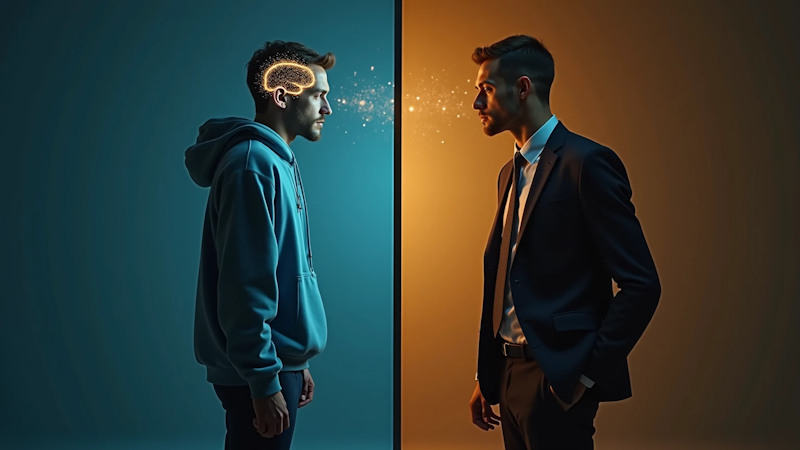
You think you’re choosing your clothes.
But what if your clothes are choosing your mindset?
What if that hoodie, that suit, that gym outfit — is literally changing your brain?
This isn’t self-help fluff. It’s neuroscience. It’s psychology. It’s something called enclothed cognition.
And once you understand how clothes are changing your brain, you’ll never get dressed the same way again.
Let’s go deeper.
The Hidden Link Between Clothing and Brain Chemistry
Here’s the truth most people ignore:
Your brain doesn’t separate “outside” from “inside” as cleanly as you think.
When you wear something, your brain doesn’t just register fabric. It registers meaning.
A lab coat.
A police uniform.
A wedding dress.
A tailored suit.
A ripped band T-shirt.
Each one carries symbolic weight. And your brain reacts to that symbolism.
Researchers at Northwestern University introduced the concept of enclothed cognition — the idea that clothing influences psychological processes. In one famous experiment, participants who wore a lab coat associated with doctors showed higher attention levels than those who didn’t.
Same coat. Different label.
When it was described as a “painter’s coat,” the cognitive boost disappeared.
That’s not fashion.
That’s your belief system changing your brain in real time.
Your brain responds to what it thinks you are.
And your clothes are feeding it that story.
Enclothed Cognition: The Science of Identity Activation
Let’s break this down simply.
Your brain constantly asks one question:
“Who am I right now?”
Clothes answer that question.
When you put on a sharp blazer, your brain activates patterns linked to competence and authority. When you wear gym clothes, it primes movement and physical readiness.
This isn’t imagination. It’s identity activation.
Think of it like this:
- A soldier in uniform stands differently.
- A lawyer in court attire speaks differently.
- A bride in her dress feels differently.
Because identity is embodied.
When your brain sees you dressed as something, it adjusts behavior to match.
That’s how clothing becomes a tool for changing your brain.
You’re not pretending.
You’re cueing neural pathways.
And those pathways influence posture, confidence, tone of voice, and even risk tolerance.
Posture, Hormones, and Power Signals
Clothing doesn’t just change perception.
It changes physiology.
When you wear structured clothing — like tailored jackets or fitted pieces — you naturally stand taller. That posture shift alters breathing. That breathing shift affects oxygen flow. And that oxygen flow influences alertness.
It’s subtle. But it’s real.
Studies on posture show that upright positioning can increase feelings of confidence and reduce stress markers.
So when you put on something that makes you hold yourself differently, you’re indirectly changing your brain chemistry.
There’s also the power effect.
Formal clothing has been shown to increase abstract thinking. People dressed formally perform better on strategic tasks. Why?
Because formal clothing signals status and control.
Your brain responds by operating at a higher conceptual level.
Clothes aren’t decoration.
They’re neurological triggers.
The Casual Trap: How Sloppy Dressing Lowers Cognitive Performance
Now here’s the uncomfortable part.
If clothes can elevate your brain, they can also lower it.
When you consistently wear overly casual, shapeless, or careless clothing, your brain registers comfort — not alertness.
Comfort isn’t bad.
But constant comfort can reduce performance.
When you dress like you’re about to nap, your brain shifts toward rest mode.
And if you’re working from home in pajamas all day?
You’re training your brain to treat work like leisure.
That’s not about discipline.
That’s about neurological association.
Your environment influences state.
Your clothing is part of your environment.
If you want to stop unconsciously changing your brain toward laziness, you need to be intentional with what you wear.
Not flashy.
Intentional.
Color Psychology: The Emotional Impact of What You Wear
Color isn’t neutral.
Red can increase heart rate.
Blue can induce calm.
Black can signal authority.
White can represent clarity.
When you wear color, your brain responds emotionally before you think logically.
That emotional shift influences behavior.
Wear red to a negotiation? You may feel more assertive.
Wear blue during conflict? You may feel calmer.
Even subtle tones matter.
Soft neutrals create openness.
Bold contrasts create intensity.
Color is a shortcut to emotional regulation.
And emotional regulation is directly tied to performance, decision-making, and communication.
So yes — the colors in your closet are changing your brain daily.
You just haven’t been paying attention.
Self-Perception Theory: You Become What You Observe
Here’s something powerful.
Your brain watches you.
According to self-perception theory, we infer our internal states by observing our behavior.
That includes how we dress.
If you consistently see yourself dressing with care, your brain concludes:
“I must value myself.”
If you consistently see yourself dressing poorly, your brain concludes:
“Effort isn’t necessary.”
It sounds small.
But identity is built through repetition.
Every outfit sends a message to your subconscious.
And over months, those messages accumulate.
That accumulation becomes personality reinforcement.
Which means your wardrobe is quietly changing your brain long-term.
The Confidence Loop: Clothes → Behavior → Feedback → Identity
Confidence doesn’t appear randomly.
It’s built through loops.
You wear something that makes you feel sharp.
You stand taller.
You speak clearly.
People respond positively.
You internalize that feedback.
Confidence increases.
That loop strengthens neural circuits associated with self-assurance.
Now reverse it.
You wear something sloppy.
You shrink slightly.
You hesitate.
People sense it.
Feedback decreases.
Confidence drops.
Same person.
Different clothing.
Different neural reinforcement.
That’s how changing your brain becomes a daily ritual without you noticing.
Clothes are leverage.
They can accelerate or sabotage identity growth.
The Athlete Effect: Why Uniforms Boost Performance
Athletes understand this instinctively.
Uniforms create mental shifts.
Put on a team jersey and your brain moves from individual mode to collective mode.
Put on running shoes and your brain anticipates motion.
There’s research showing that simply wearing athletic gear increases likelihood of exercising.
Because the brain prepares for action.
It’s called cognitive priming.
The outfit signals intention.
And intention shapes behavior.
If you want to train your brain toward productivity, creativity, or discipline, dress for it.
Don’t wait to feel ready.
Dress ready.
Your brain will follow.
Mirror Neurons and Social Feedback
Here’s another layer.
Humans are social creatures.
Your clothing influences how others treat you.
And their reactions influence your neural state.
When someone responds to you with respect, your brain releases dopamine. When someone dismisses you, cortisol can rise.
Your outfit affects first impressions within seconds.
Those impressions shape interaction tone.
That tone feeds back into your brain.
So clothing isn’t just internally changing your brain.
It’s externally shaping how others interact with you — which then changes your brain again.
It’s a loop.
A powerful one.
How to Intentionally Use Clothing to Rewire Your Brain
Now the practical part.
If clothes are already changing your brain, use them strategically.
Here’s how:
1. Dress for the identity you’re building.
Not the one you’re escaping.
2. Separate work clothes from relaxation clothes.
Train your brain to recognize different modes.
3. Use color deliberately.
Calm days? Blue.
Bold moves? Red.
Deep focus? Dark neutrals.
4. Prioritize fit and structure.
Structured clothing subtly improves posture and alertness.
5. Create ritual transitions.
Change clothes to signal mental shifts. Gym clothes before training. Sharp clothes before creative work.
The key isn’t expense.
It’s intention.
When you consciously choose clothing to support your goals, you’re actively changing your brain in your favor.
The Danger of Ignoring This Science
Most people underestimate small variables.
They think transformation requires dramatic change.
But neuroscience tells a different story.
Micro cues shape macro identity.
Your brain is plastic. It rewires constantly.
Every repeated association strengthens neural circuits.
If your daily clothing reinforces passivity, low energy, or invisibility, your brain adapts accordingly.
If it reinforces confidence, clarity, and strength, your brain adapts accordingly.
You are training your nervous system daily.
The question is:
Are you training it intentionally?
Or accidentally?
Final Truth: You’re Not Just Getting Dressed
You’re programming.
Every morning when you choose an outfit, you are sending instructions to your nervous system.
Signals about status.
Signals about energy.
Signals about who you believe you are.
And over time, those signals compound.
Clothing won’t solve your life.
But it can support your evolution.
Because identity isn’t just mental.
It’s embodied.
And embodiment is powerful.
So tomorrow morning, pause.
Before you throw on whatever’s easiest, ask yourself:
“What version of me am I reinforcing today?”
Because whether you realize it or not…
Your clothes are changing your brain.