Every generation crowns its own myth.
Not loudly. Not officially.
It happens quietly—through repetition, quotes, and a strange sense that this story explains something about power we couldn’t name before.
For many people, The Godfather once held that place.
Now, more and more viewers are asking the same question about Yellowstone—not because the stories are identical, but because the emotional role they play feels eerily similar.
This isn’t about plots.
It’s about what these stories teach us to feel normal about.
And that’s where things get interesting.
A Story That Explains Power Without Apologizing
Both sagas arrive with a quiet confidence. They don’t beg for approval. They don’t soften their edges. They simply exist, and invite you to catch up.
What they share is a refusal to moralize in obvious ways.
Power is not portrayed as heroic.
But it’s also not condemned.
It’s treated as inevitable.
That alone changes how a story lands. When power is shown as something ancient, inherited, and deeply personal, viewers stop asking “Is this right?” and start asking “What would I do?”
That’s the pivot.
That’s how a show becomes a cultural mirror.
The Patriarch as Gravity, Not a Hero
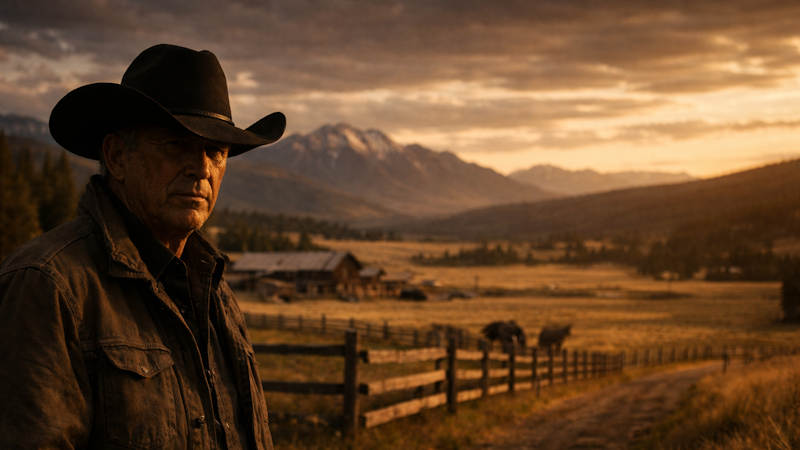
At the center of both worlds stands a man who doesn’t chase authority. Authority bends toward him.
In Yellowstone, John Dutton isn’t charismatic in a flashy way. He’s heavy. He carries silence like a weapon. When he speaks, it’s rarely to persuade—more often to close doors.
This mirrors the older archetype perfected decades ago: the patriarch whose power comes from restraint, not noise.
These men don’t dominate rooms by volume.
They dominate by making everyone else adjust.
That kind of leadership feels unsettling—and familiar. It echoes how power often operates in real life: informal, inherited, unspoken.
And viewers recognize it instantly.
Family First—But at a Cost
Here’s where both stories tighten their grip.
Family isn’t just important.
Family is everything.
But “everything” comes with a price.
Loyalty becomes currency.
Love becomes conditional.
Affection is rationed like land.
Children aren’t asked what they want. They’re asked what they’ll sacrifice.
In both worlds, family is the justification for cruelty and the excuse for tenderness. That contradiction is never resolved. It’s simply lived with.
That tension—between protection and control—is what keeps viewers emotionally invested long after the plot details fade.
Violence That Feels Inevitable, Not Sensational
Neither saga treats violence as spectacle.
It arrives calmly. Sometimes quietly.
Often without music.
That’s important.
When violence is framed as maintenance, not chaos, it changes how we process it. It becomes part of the system—like pruning a tree or repairing a fence.
In Yellowstone, violence doesn’t shock as much as it confirms. It reassures the audience that the rules still apply, that the world hasn’t drifted into sentimentality.
That emotional effect is identical to what The Godfather achieved in its time.
Violence becomes a language.
And everyone in the room understands it.
Territory as Identity
In one world, it’s New York.
In the other, it’s Montana.
Different landscapes. Same psychology.
Land isn’t just property. It’s memory, blood, inheritance, and threat—all wrapped into one.
To lose territory is to lose selfhood.
That’s why compromise is treated as betrayal. Why negotiation feels like surrender. Why the land itself becomes a character—silent, demanding, eternal.
Viewers don’t just watch people fight over land.
They watch people fight over meaning.
And that’s timeless.
Why This Story Resonates Now
Here’s where Yellowstone earns its comparison.
It arrives in an era of instability—economic, cultural, emotional. Institutions feel fragile. Rules feel negotiable. Authority feels abstract.
Into that uncertainty steps a story that says:
Power is real. Blood matters. Lines exist. Consequences are enforced.
That clarity is intoxicating.
Not because people want cruelty—but because they crave structure.
The show doesn’t promise fairness.
It promises order.
And in chaotic times, order feels like comfort.
Masculinity Without Redemption Arcs
One of the boldest parallels is how both stories portray masculinity.
There is no self-help language.
No emotional literacy arc.
No final confession that fixes everything.
Men feel deeply—but act sparingly.
They love—but through protection, not reassurance.
This doesn’t make them admirable. It makes them coherent within their world.
Modern audiences often pretend this form of masculinity disappeared. These stories quietly remind us it never did.
It just changed uniforms.
The Role of Women: Not Peripheral, Not Soft
Another shared strength is how women operate within these power systems.
They are not sheltered from violence.
They are not naive.
They understand the rules—and often play them better.
Women in Yellowstone don’t seek permission. They seek leverage.
That mirrors the older saga’s insistence that power doesn’t belong to gender—it belongs to those willing to endure its costs.
This realism, however uncomfortable, is part of what gives both stories their weight.
Why People Rewatch—Not Just Watch
Here’s a quiet test of cultural longevity:
Do people rewatch it not for the plot, but for the feel?
With both stories, viewers return not to be surprised—but to inhabit the world again. To sit in its silence. To feel its rules press down gently.
Rewatching becomes ritual.
And rituals are how myths survive.
The Difference That Still Matters
Despite all these parallels, the comparison isn’t perfect—and that’s important.
The Godfather is mythic and contained.
Yellowstone is expansive and ongoing.
One is sculpted like a statue.
The other grows like a ranch—messy, seasonal, exposed to weather.
That makes Yellowstone more vulnerable to dilution. Longevity can erode sharpness. Repetition can soften meaning.
Whether it maintains its mythic status depends on restraint—something serialized television struggles with.
So… Is It the New Godfather?
Not in form.
Not in medium.
Not in tone.
But in function?
Yes—dangerously close.
Both stories help audiences make sense of power without comforting lies. They refuse to moralize loudly. They invite viewers to sit with discomfort instead of resolving it.
They become reference points. Shortcuts in conversation. Emotional vocabulary.
When a show does that, it stops being entertainment.
It becomes cultural infrastructure.
And that’s the real legacy people are sensing—often without realizing why.
Final Thought
Every era gets the stories it can emotionally tolerate.
The fact that Yellowstone resonates so deeply right now says less about cowboys and ranches—and more about our hunger for structure, lineage, and consequence.
Whether it will endure the way The Godfather has remains an open question.
But the comparison itself?
That’s already an answer.
SHARE THIS